
guide
How monthly contributions grow
Separate the amount deposited from projected growth.
Free planning tool
Explore how your starting amount, regular deposits, and time could add up.
Estimated ending balance
This is a fixed-rate projection. Actual returns can change; taxes, fees, and inflation are excluded.
Starting amountDepositsInterest
Make the estimate useful
Use your calculated result without creating an account. Files and saved scenarios stay with you.
Save one set of assumptions for this calculator. It remains on this device until you remove it. Avoid saving on a shared device. This is separate from analytics consent.
The link contains the displayed summary and financial results. Anyone with it can read them. It does not include form inputs or the full projection, and is not encrypted. Only share information you are comfortable disclosing.
A is kept only while this page is open. Compare the assumptions below; different timelines or modes may answer different questions.
Components are rounded independently; their displayed differences can vary from the balance difference by a cent.
These figures compare the full scenarios. They do not isolate the effect of any one assumption or guarantee a return.
| Detail | Scenario A | Latest result B |
|---|
Values are shown in US dollars and rounded for display.
| Year | Ending balance | Total deposited | Interest |
|---|
Understand the estimate
Use this compound interest calculator to project an initial balance plus regular monthly, quarterly, semiannual, or annual contributions. Set compounding and deposit timing separately, then inspect annual growth, compare scenarios, and export the estimate.
The annual rate you enter is treated as a fixed nominal rate. We turn it into an effective rate for each deposit interval using (1 + annual rate ÷ compounding periods)^(compounding periods ÷ deposit periods). Each deposit is added before or after that interval's growth, based on your selection. Interest stays in the balance and can earn more interest.
How to read the result: separate the starting amount and additional deposits from projected interest. The year-by-year table shows when growth begins to account for more of the balance, while scenario comparison lets you change one assumption at a time.
Assumptions and limits: When deposit and compounding schedules differ, the model spreads effective growth evenly across deposit intervals. It does not model exact calendar dates, taxes, fees, inflation, or changing returns. Negative rates are allowed to explore losses; projected interest can be negative. This is an educational estimate, not a guaranteed outcome or investment advice.
Read the complete calculation method and a worked example. For more context, see the Investor.gov calculator and the CFPB explanation of compound interest.
Learn more about monthly contributions, compounding frequency, or review worked compound interest examples.
Worked example
Start with $1,000, add no deposits, use a 5% annual rate, and choose two years with annual compounding. The first year ends at $1,050. The second year applies 5% to that larger balance, producing $1,102.50. The projected interest is $102.50.
Try this example in the calculatorCommon questions
Compound interest is interest calculated on the starting balance and on interest that has already been added. That is why time and the compounding schedule affect the estimate.
Yes. Choose monthly deposits, enter the amount, and select whether each contribution arrives at the beginning or end of the month. Other deposit frequencies are available too.
No. Compounding frequency controls how often interest is added. Contribution frequency controls how often you add money. This calculator lets you set them separately.
Not necessarily. With the same nominal rate, more frequent compounding increases the effective return, but the difference may be small at modest rates and shorter time horizons.
No. The projection excludes taxes, fees, inflation, changing returns, and market losses unless you enter a negative fixed rate.
No. It is an educational fixed-rate scenario. Actual savings and investment results can differ.
Independent tools. Shared progress.
Managing your financial future shouldn't require expensive software or complicated spreadsheets.
That's why I'm building simple, accessible financial tools to help people plan their savings and understand compound growth.
Our calculators are completely free. If you find them useful, purchasing our $15 Savings & Growth Workbook gives you more powerful planning tools while supporting the development of new free resources.
Explore the workbook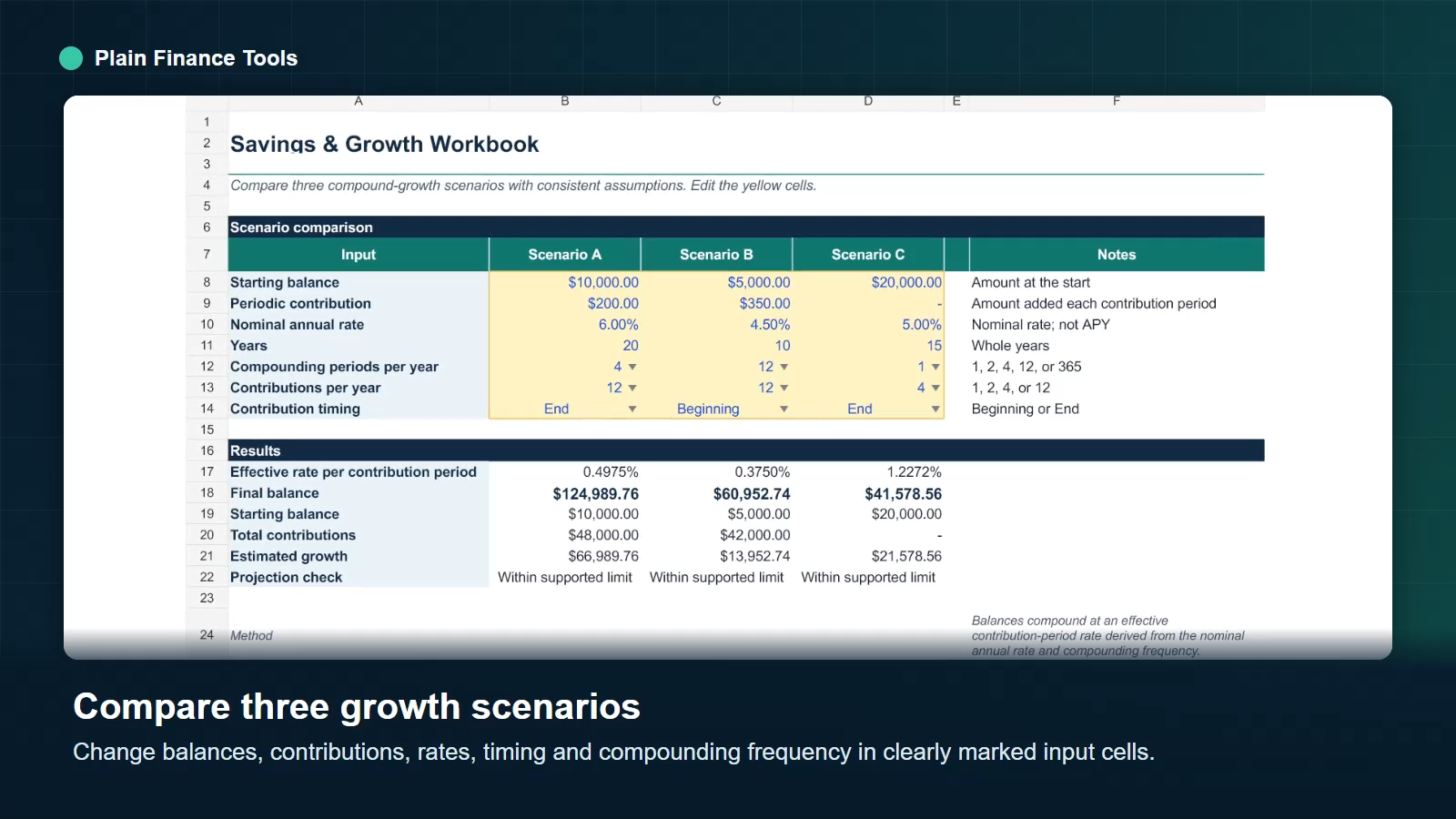 Compare scenarios. Keep your plan.